
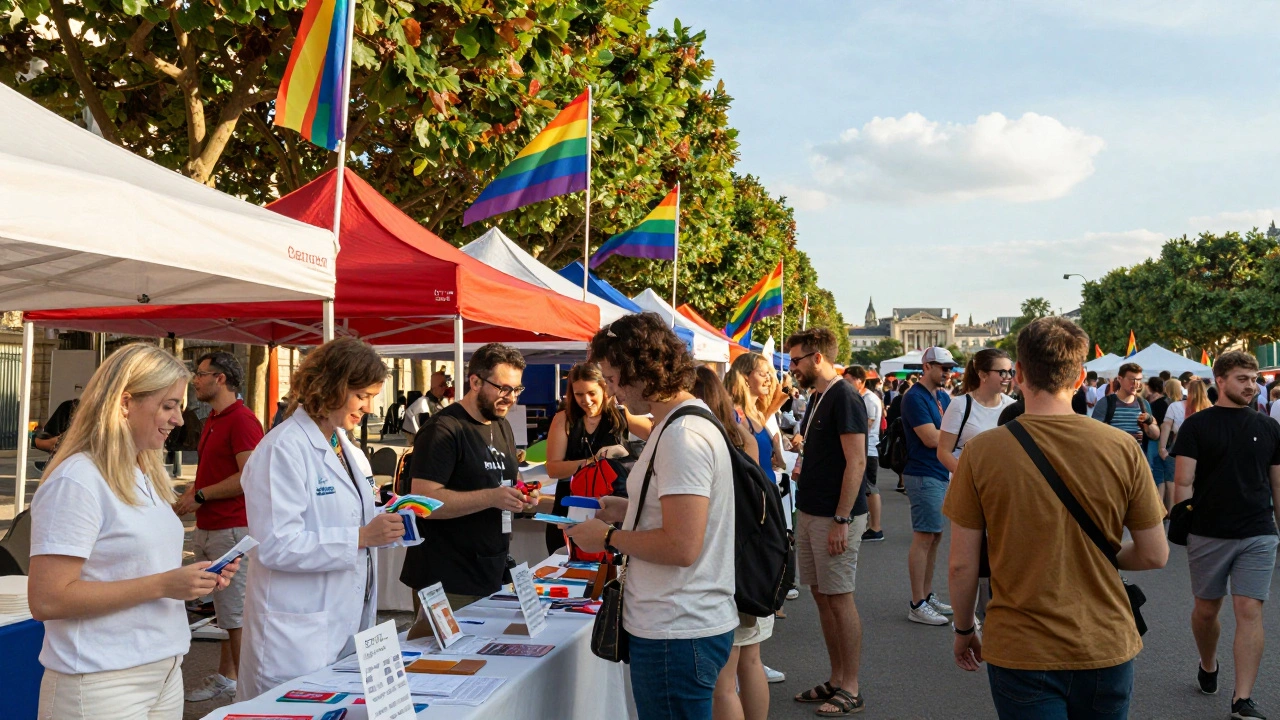
In Paris, where the Seine winds past centuries-old cafés and rainbow flags flutter above Montmartre, LGBTQ+ people face unique barriers to sexual health-even in one of Europe’s most progressive cities. While Paris boasts vibrant pride parades and open-minded neighborhoods like Le Marais, access to culturally competent care isn’t automatic. Many queer individuals still delay testing, avoid discussing their needs with doctors, or struggle to find providers who understand their realities. The truth is, sexual health in Paris isn’t just about condoms and clinics-it’s about trust, language, and belonging.
Barriers to Care in Paris
Despite France’s universal healthcare system, LGBTQ+ people in Paris often feel invisible in medical settings. A 2024 survey by Paris LGBT+ Santé found that 42% of trans and non-binary respondents had been misgendered by a healthcare provider in the past year. For many, that single experience is enough to avoid future visits. Even when care is available, it’s not always easy to find.
Language is another hurdle. While many Parisian doctors speak English, they rarely receive training in queer-specific health needs. A gay man from the 11th arrondissement might walk into a clinic asking for PrEP and be handed a leaflet on ‘safe sex for couples’-as if his relationship status were the only factor. Trans women in the 18th arrondissement report being asked invasive questions about their surgeries during routine STI screenings, making them feel like their bodies are public property.
And then there’s the stigma. In neighborhoods like Belleville or the outer suburbs of Seine-Saint-Denis, conservative attitudes still linger. Young queer people from immigrant families may hide their identities entirely, avoiding testing for fear of being outed to parents or community leaders. The silence isn’t just personal-it’s systemic.
Where to Get Care in Paris
Thankfully, Paris has built a network of queer-led health services that fill the gaps left by mainstream providers. One of the most trusted is Le Centre LGBT+ Paris Île-de-France, located near Place de la République. They offer free, confidential STI testing, PrEP prescriptions, hormone therapy coordination, and counseling-all staffed by LGBTQ+ professionals who speak the language of lived experience.
Another key player is Sidaction, a national organization with a dedicated Paris office on Rue du Faubourg Saint-Antoine. Their mobile testing van rolls through neighborhoods like the 13th and 19th arrondissements every other Thursday, offering rapid HIV and syphilis tests with results in under 20 minutes. No appointment needed. No judgment.
For trans and non-binary residents, Trans’Action Paris partners with hospitals like Hôpital Saint-Louis to provide hormone therapy referrals and legal gender marker support. Their team includes peer navigators-people who’ve walked the same path-who help newcomers fill out paperwork, find therapists, and even practice what to say when a doctor says something offensive.
Even pharmacies play a role. In Le Marais, Pharmacie du Temple and Pharmacie de la Roquette stock PrEP without a prescription for those with EU health coverage. Pharmacists there are trained to explain how to take it, what side effects to watch for, and how to refill-no lecture, no shame.
PrEP and PEP: What You Need to Know
PrEP (pre-exposure prophylaxis) is a daily pill that reduces HIV risk by over 99% when taken correctly. In Paris, it’s covered by France’s national health insurance for anyone at risk-including gay and bisexual men, trans women, and sex workers. You don’t need to be French to qualify; EU residents and long-term visa holders can get it too.
Getting PrEP is simple: walk into any Centre de Santé Sexuelle or ask your general practitioner for a referral. Many clinics in Paris offer same-day consultations. If you’re nervous about talking to your doctor, try PrEP’Paris, a peer-led hotline (0800 88 10 88) where you can ask questions anonymously before booking an appointment.
PEP (post-exposure prophylaxis) is the emergency option. If you’ve had unprotected sex or a condom broke, PEP can prevent HIV if taken within 72 hours. It’s available at all emergency rooms in Paris-Hôpital Cochin, Hôpital Tenon, Hôpital Avicenne-and even at some pharmacies after hours. Just say: ‘Je besoin de PEP’-you’ll be helped immediately.

Testing Is Routine, Not Rare
Getting tested shouldn’t feel like a crisis. In Paris, you can walk into a clinic and get a full STI panel-including HIV, syphilis, gonorrhea, and chlamydia-in under 30 minutes. Many places offer self-testing kits you can pick up for free: Test’Ici distributes them at gay bars like Le Palais Royal and La Bâtie, and at community centers in the 10th and 12th arrondissements.
Some services even let you order kits online and mail them back anonymously. Testez-vous.org, run by the French Ministry of Health, sends free kits to any Paris address. Results come via encrypted SMS. No name. No ID. Just peace of mind.
And don’t wait for symptoms. Most STIs show none. A 2023 study by Institut Pasteur found that 68% of new HIV cases in Paris were diagnosed late-because people didn’t test regularly. Testing every 3-6 months is the standard for sexually active queer people. It’s not paranoia. It’s self-care.
Community and Connection
Health isn’t just physical. It’s emotional. In Paris, queer people are building spaces where wellness is shared, not just prescribed.
Les Mains Libres, a queer women’s collective in the 11th, hosts monthly ‘Sex & Safety’ circles where people talk about boundaries, pleasure, and past trauma in a safe, no-judgment space. They’ve trained over 200 people in consent workshops since 2022.
La Maison des Ligues in the 19th arrondissement runs free yoga and mindfulness classes specifically for trans and non-binary folks. The instructor, a trans woman named Amina, says: ‘When your body feels like a battlefield, movement can be a home.’
And then there are the events. Every June, Paris Pride isn’t just a parade-it’s a week-long health fair. Over 15,000 people attend, getting tested, picking up free lube and condoms, and meeting counselors from ACT UP Paris and Inter-LGBT. In 2024, over 1,200 people started PrEP after attending the fair.
What You Can Do Today
You don’t need to wait for Pride Month or a crisis to take charge of your sexual health. Here’s what you can do right now:
- Download the PrEP’Paris app-it maps free testing centers, explains insurance rules, and lets you book appointments in French or English.
- Visit Le Centre LGBT+ Paris Île-de-France for a free consultation. No appointment needed on Wednesdays.
- Ask your local pharmacy for a free STI test kit. If they say no, ask for the manager. They’re required by law to provide them.
- Text ‘TEST’ to 31149 for a confidential SMS with the nearest testing location.
- If you’re trans or non-binary, call Trans’Action Paris at 01 42 02 88 88. They’ll help you find a doctor who won’t make you explain your identity just to get a flu shot.
Sexual health in Paris isn’t about perfection. It’s about showing up-for yourself, for your partners, for your community. The city has the tools. You just need to ask.
Is PrEP free in Paris for non-French residents?
Yes. If you’re an EU citizen or have a long-term French residence permit, PrEP is fully covered by France’s national health insurance. Tourists and short-term visitors can buy it at pharmacies for around €20-€30 per month. Some clinics, like Le Centre LGBT+, offer discounted or free PrEP for those without coverage.
Where can I get free condoms in Paris?
Free condoms are available at all Centre de Santé Sexuelle locations, pharmacies with a ‘PrEP & Condoms’ sign, and at LGBTQ+ venues like Le Palais Royal, La Bâtie, and Le Cercle. You can also pick them up at the Paris City Hall (Hôtel de Ville) during public health events.
Are there English-speaking LGBTQ+ health providers in Paris?
Yes. Le Centre LGBT+ Paris Île-de-France and Sidaction both have staff who speak fluent English. The Paris LGBT+ Health Hotline (0800 88 10 88) offers English support Monday to Friday, 9 AM to 6 PM. Many private clinics in the 8th and 16th arrondissements also cater to expats.
Can I get gender-affirming care without a diagnosis?
Under France’s 2022 gender recognition law, you no longer need a psychiatric diagnosis to access hormone therapy or change your legal gender. You only need to submit a simple declaration to the town hall. Many clinics, including Trans’Action Paris, offer peer-led guidance to help you through the process.
What should I do if I’m discriminated against at a clinic?
Document what happened-date, time, name of provider, what was said. Then contact Inter-LGBT (inter-lgbt.org) or Le Centre LGBT+ Paris Île-de-France. They’ll help you file a formal complaint with the French Health Authority (HAS). Discrimination based on sexual orientation or gender identity is illegal under French law.
Next Steps
If you’ve never been tested, start today. Walk into Le Centre LGBT+ on a Wednesday. Text ‘TEST’ to 31149. Call the hotline. You don’t need to be ready. You just need to show up.
If you’re a friend or ally, don’t wait for someone to ask for help. Ask them: ‘Have you thought about getting tested?’ Offer to go with them. Share the PrEP’Paris app. Normalize the conversation.
Sexual health in Paris isn’t a privilege reserved for the loud or the lucky. It’s a right-and it’s waiting for you, right around the corner, in a clinic, a pharmacy, or a quiet café near the Canal Saint-Martin.